

If you have spent any time in the software engineering world, you know the power of the grid.
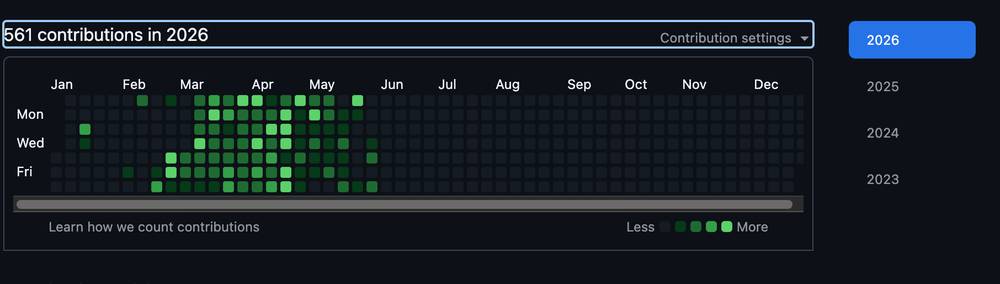
In the screenshot you can see my personal contribution graph for 2026. At first glance, it’s just an array of colored pixels. But if you look closer, you can trace the exact trajectory of a developer shifting gears from passive learning to relentless, production-grade building.
As of June, the counter stands at 561 contributions. Looking back at the massive, vibrant green blocks stretching across March, April, and May, I wanted to break down exactly what those squares represent, the technical reality behind them, and why consistency is the ultimate force multiplier when you're teaching yourself to scale software.
The Illusion of the Graph vs. The Reality of Code
Let’s bust a common myth right out of the gate: A green square doesn’t mean you wrote perfect code.
It’s incredibly easy for junior developers to get trapped in "tutorial hell"—watching hours of video, reading endless documentation, and feeling like they are making progress when they haven't actually touched a code editor. The graph forces you to confront a hard truth: Did you ship today?
When I look at that dense block of green in April and May, I don't just see metrics. I see the invisible architecture of what was happening under the hood on my projects:
- Wrestling with State: Transitioning from simple CRUD operations to managing complex, real-time asynchronous interactions in JavaScript.
- System Design Thinking: Figuring out how to structure real-time notifications and feed architectures without melting the database.
- Polishing UI/UX: Moving past generic layouts to craft snappy Tailwind interfaces, loading states, and responsive views that feel like native apps.
Every single one of those squares represents a micro-decision. A bug fixed, a Git branch merged, a feature deployed.
Inside the Engine: What Counts as a "Contribution"?
From a system design perspective, a contribution graph is just a specialized time-series data visualization. But building one teaches you a lot about data tracking. To the Git engine, a "contribution" isn't a vague concept—it is strictly bound to specific actions:
- Commits: Committing code to a repository's default branch (or a branch that gets merged into it).
- Pull Requests & Issues: Opening, reviewing, or closing PRs and tracking tasks.
The Technical Trap: Quantity Not Equal To Quality
It is incredibly easy to game the system. You could technically write a Python script that modifies a text file and pushes a commit every 5 minutes to generate a perfectly dark green grid.
Total Commits Not Equal T Total Skill
But engineering isn't about padding stats. The true value of tracking your output is momentum tracking. When you commit to making at least one meaningful architectural or logical update a day, you build a psychological chain you don't want to break. The graph is simply a visual reflection of discipline.
From Consumer to Builder: The March Shift
If you look closely at the screenshot, you'll notice January and February are relatively quiet. That was the consumption phase—absorbing concepts, reading documentation, and planning out systems.
Then came March. That’s the exact moment the switch flipped from learning about code to building real software.
When you transition into building full-stack applications, your daily cadence changes. You stop asking, "How do I write a loop?" and start asking:
- "How do I handle image/media uploads efficiently?"
- "Should I use WebSockets or long polling for this feature?"
- "How do I write clean, production-ready code that doesn't rely on unnecessary abstractions?"
The green wall you see in the spring is the result of answering those questions with raw execution.
What’s Next for the Rest of 2026?
561 contributions is a milestone, but the year is only halfway through. The goal for the next stretch isn't just to keep the grid green, but to make the underlying code deeper, faster, and more scalable.
We are moving past the basics of full-stack mechanics into the world of performance optimization, advanced system architecture, and building features that feel seamless to the end user.
To anyone else staring at a blank grid or trying to break out of a learning plateau: Stop overthinking the perfect architecture and start making your first commit. Pick a feature, break it down into small pieces, and turn one square green today.
What does your development loop look like right now? Are you in a deep learning phase, or are you in the middle of a massive shipping streak? Let's talk about it in the comments below.
Loading thoughts...